


12 Jun Architecting the Unknown—A Paper and Presentation for the EDEN 2026 Conference
CONFERENCE PROCEEDING
What happens when students become co-developers of their institution's AI literacies?

Overview
Led by Dr. Claudia Arcolin (UT San Antonio), with co-authors Dr. Angela Gunder (Opened Culture, University of Arizona), Dr. Melissa Vito (UT San Antonio), and Dr. Marcela Ramirez (UT San Antonio), this experience paper challenges a pattern visible across higher education. As organizations race to develop AI strategies, students appear in their planning documents as populations to be prepared, upskilled, or protected, rarely as collaborators who shape the strategy itself. The paper asks how open educational practices can serve as a conceptual framework for learners engaging with AI, and argues that repositioning students as co-developers of institutional AI literacies creates a reciprocal dynamic in which those literacies are activated and deepened at the same time.
The argument rests on a distinctive feature of the Dimensions of AI Literacies taxonomy (Gunder et al., 2024) and its learner-facing companion, the Dimensions of AI Literacies for Learners (Gunder et al., 2026). The eight dimensions describe both the literacies practitioners activate when designing AI-integrated learning and the literacies learners develop through that engagement. When students occupy both roles at once, creating resources for others while learning through the act of creation, open educational practices become the mechanism that makes the work durable and transferable. Read alongside the WCET AI Education Policy, Guideline, and Practice Ecosystem Framework and the Digital Education Council AI Literacy Framework, the taxonomy helps explain how student co-development moves learners across governance, operations, and pedagogy rather than confining them to the pedagogical domain alone.
To investigate the question, the authors examine the Student AI Partner Internship (SAIP) at the University of Texas at San Antonio, a paid undergraduate program launched by the Vice Provost for Academic Innovation. Piloted with six interns in summer 2024 and expanded to twelve in spring 2025, SAIP positions students as a cohort who test generative AI tools, partner with faculty and staff on integration projects, and serve as peer mentors. Interns earn microcredentials in AI and communication, and their work produces openly licensed guides, tutorials, and engagement resources shared under Creative Commons with the campus community and beyond. The model builds on UT San Antonio’s Generative AI Global Community of Practice, developed with Swinburne University of Technology, extending to students the collaborative sensemaking and relational trust that community established for faculty.
Through ethnographically informed portraits and program evaluation data, the paper illustrates the reciprocal dynamic in practice. Students who create professional development resources for faculty activate constructive and communicative literacies through the work and deepen critical and civic literacies through the research, evaluation, and open-licensing decisions the work demands. Students who coach peers activate confident and cultural literacies, and gain cognitive ground through the act of teaching a fast-moving subject they are still learning themselves. Evaluation data point in the same direction: in a recent cohort survey, ten of twelve respondents had added SAIP work to a resume or CV, nine applied SAIP skills to coursework or research, and eight planned to stay engaged with AI initiatives on campus, with one student describing a shift from surface-level tool use toward understanding how models work and what that implies.
Read together, the portraits and the data make a transferable case. When students are invited to create the resources that support AI integration, and when those resources are shared openly, the institution gains capacity and credibility while students gain literacies that no pre-packaged training can provide. For distance education in particular, where AI adoption is accelerating and professional development is unevenly distributed, student-produced open educational resources offer an approach that is responsive, scalable, and grounded in the lived experience of the learners these programs serve. Institutions need not replicate every element of the UT San Antonio model; the core principle is portable, beginning small and scaling on evidence of impact.
Related Resources
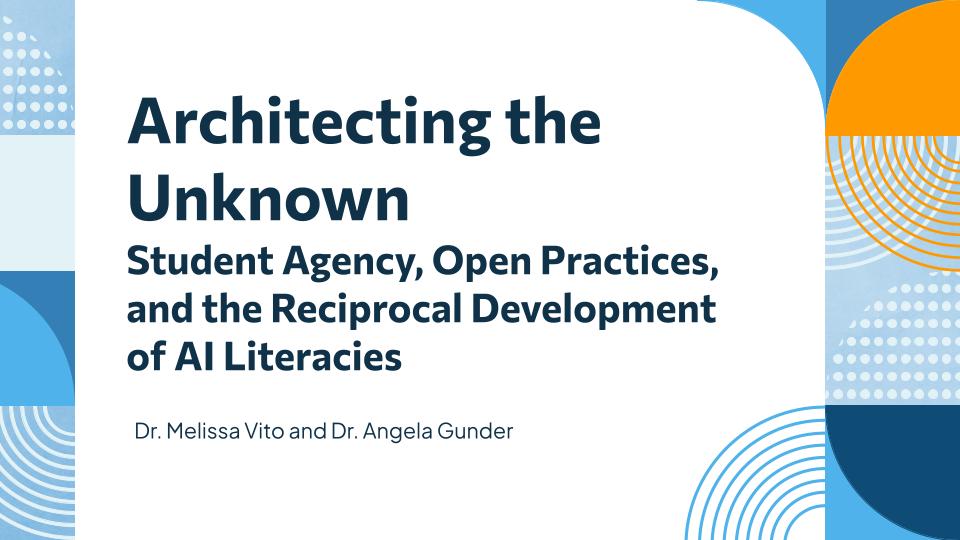
This paper and its companion presentation were developed for the EDEN 2026 Conference, held in Porto, Portugal, from 14–16 June 2026 and hosted by the University of Porto. Click on the slide title image below to open the presentation in Google Slides.
Author Reflections
To accompany the in-person presentation, some of the co-authors recorded brief video reflections offering personal context for the research—discussing its relevance to their leadership experiences and its implications for the future of academic innovation.
Links to Publications and Other Resources
- Dimensions of AI Literacies Taxonomy
- Dimensions of AI Literacies Taxonomy for Learners
- Paper: Constellating AI Literacies: Illuminating the Sociocultural and Pluralistic Dimensions of AI in Education
- Resource: WCET AI Education Policy and Practice Framework
- Playbook: AI Literacies in Practice (WCET)
