


12 Jun AI Governance and the Development of AI Literacies—A Paper and Presentation for the EDEN 2026 Conference
CONFERENCE PROCEEDING
How does a community turn imagined futures into strategy it can act on now?

Overview
Led by Dr. Nicole Johnson (Nicole Johnson Research and Consulting), with co-authors Dr. Angela Gunder (Opened Culture, University of Arizona), Dr. Melissa Vito (UT San Antonio), Dr. Joshua Steele (University of Tennessee, Knoxville), Dr. Joshua Herron (University of Arizona Global Campus), and Dr. Cristi Ford (D2L), this paper addresses a gap in the evidence base. Higher education institutions face mounting pressure to integrate AI into academic programs while establishing governance that is responsible and adaptable, yet little empirical research examines how academic leaders make governance decisions. The study takes up two questions: how academic leaders navigate and make decisions about AI governance, and how the development of AI literacies relates to that decision-making.
To investigate, the authors read their data through two analytical structures developed in their prior work. The WCET AI Education Policy and Practice Framework organizes institutional AI integration across governance, operations, and pedagogy, and this study focuses on governance, the domain through which institutions define their visions and values for AI, weigh risk, and communicate shared responsibility. The Dimensions of AI Literacies taxonomy names eight interconnected dimensions, Cultural, Cognitive, Constructive, Communicative, Confident, Creative, Critical, and Civic AI Literacies, and is applied here at the institutional level to examine which literacies organizations employ and develop through governance work.
The analysis pairs a thematic review of published scholarship with preliminary survey findings. From 49 works located on AI literacies frameworks, sixteen were suitable for inclusion in the thematic analysis, which then informed a survey distributed in spring 2026 through the research team’s networks and supporting organizations. Forty-six respondents, including administrators, faculty, and staff leading teaching and learning centers, AI initiatives, and institutional research, answered five open-ended questions, with participants drawn mostly from the United States alongside Australia, Canada, Egypt, Israel, and the United Kingdom. As the exploratory stage of a larger grounded theory study, the findings are framed as early and not generalizable, with further interviews and reflections to follow.
On the first question, governance activity clustered around three themes named in the WCET framework: policy and ethics, leadership and culture, and institutional accountability. The data also surfaced persistent challenges. Governance efforts were frequently fragmented and siloed across IT, faculty groups, and administrative offices, with ad hoc task forces that lost momentum once immediate urgency passed and lines of accountability that remained unclear. Leaders described a tension between the need to move quickly amid rapid AI adoption and the fear that premature or rigid policy could stifle innovation or quickly become obsolete, a tension that often produced incremental updates rather than durable structures. Alongside these challenges, institutions reported promising steps, from sensemaking approaches and cross-functional steering committees to embedding AI oversight into existing governance bodies and everyday operations.
On the second question, the study makes its central contribution: governance work and AI literacies development are deeply intertwined, with governance functioning as a site where those literacies are practiced and grown. Institutions that brought diverse voices into policy formation were developing Civic and Cultural AI Literacies, those that interrogated bias and risk were deepening Critical AI Literacies, and those that evaluated how AI tools function within their systems were strengthening Cognitive AI Literacies, while the collaborative drafting of policy nurtured Confident AI Literacies across leadership teams. From this reciprocal relationship the paper draws opportunities for the field: build governance structures that are permanent and adaptable rather than short-lived, make transparency and communication central, incorporate student perspectives and access considerations, and treat policy development itself as a form of collective capacity-building. Understood this way, governance becomes a vehicle for growing institutional AI capacity, extending its role beyond the management of risk.
Related Resources
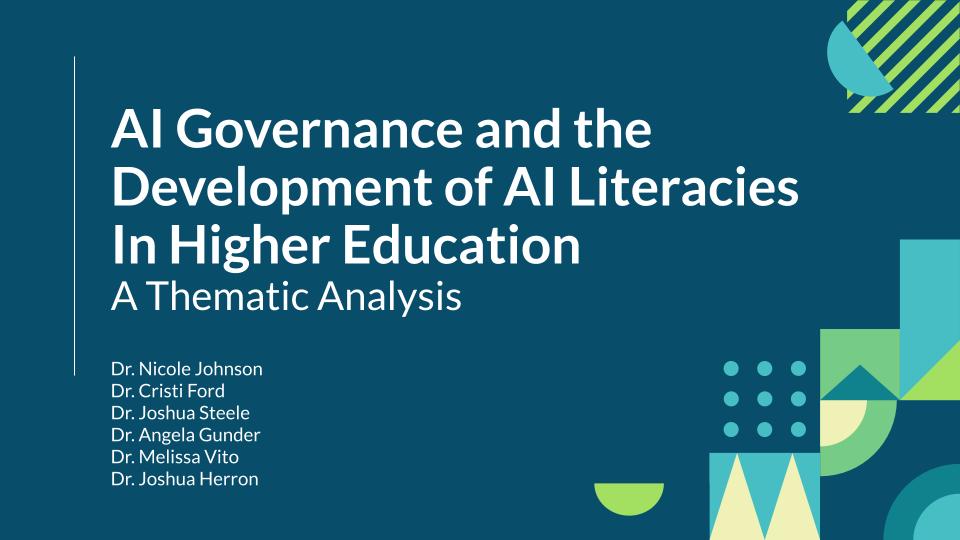
This paper and its companion presentation were developed for the EDEN 2026 Conference, held in Porto, Portugal, from 14–16 June 2026 and hosted by the University of Porto. Click on the slide title image below to open the presentation in Google Slides.
Author Reflections
To accompany the in-person presentation, some of the co-authors recorded brief video reflections offering personal context for the research—discussing its relevance to their leadership experiences and its implications for the future of academic innovation.
Links to Publications and Other Resources
- Participate in Study on AI Governance
- Resource: AI Education Policy, Guideline, and Practice Ecosystem Framework (WCET)
- Resource: Dimensions of AI Literacies
- Report: AI Literacies in Focus: From Frameworks to Action (WCET)
- Paper: Constellating AI Literacies: Illuminating the Sociocultural and Pluralistic Dimensions of AI in Education
