


07 Nov AI and the Evolution of Research and Learning Design: A Digital Ethnography of Emergent Practices and Perspectives—A Paper and Presentation for the ICDE 2025 World Conference
CONFERENCE PROCEEDING
How can research keep pace with AI when the landscape changes faster than our ability to publish?

Overview
Led by Dr. Angela Gunder (Opened Culture, University of Arizona) with co-authors Dr. Joshua Herron, Dr. Nicole Weber, and Dr. Colette Chelf, this project began with a simple provocation: By the time our research on AI in education is published, how much of it will already be obsolete?
The team conducted a digital ethnography tracing real-time experimentation among learning designers, faculty, and technologists using AI to redesign courses, develop assessments, and explore creative pedagogies. The methods emphasized participatory adaptation—observation and co-creation occurring simultaneously across shared online spaces. Every prompt, workflow, and prototype became both data and dialogue, transforming the research itself into an intervention within the learning design community.
Across hundreds of artifacts and reflections, three key patterns emerged:
- The Half-Life of Knowledge. Traditional research cycles struggle to stay relevant in the face of AI’s rapid evolution. By circulating findings openly and iteratively, the study sought to renew knowledge before it decayed.
- The Prototype as Publication. In an AI-mediated research culture, the prototype becomes the new scholarly artifact. Each in-progress experiment, prompt, or reflective post contributes to collective understanding.
- Learning at the Speed of Change. Sustainable innovation requires shared infrastructure for rapid learning. Opened Culture emerged as such an infrastructure—an ecosystem where ethnographic insights and design practices circulate across institutions.
Together, these findings reframe research as open, iterative, and ecological. Rather than producing fixed answers, the project models “knowledge in motion”—research that evolves through remix, reflection, and reciprocity.
The work culminated in two complementary open initiatives hosted by Opened Culture:
- The Digital Ethnography of AI and Learning Design, a living study continually updated with new cases and interviews.
- The AI Case Example Database, a collective repository where educators share in-flight experiments, reflections, and failures to extend the life of their learning.
Both platforms invite ongoing contribution and critique, ensuring that research on AI and learning design grows through participation rather than publication delay.
Related Resources
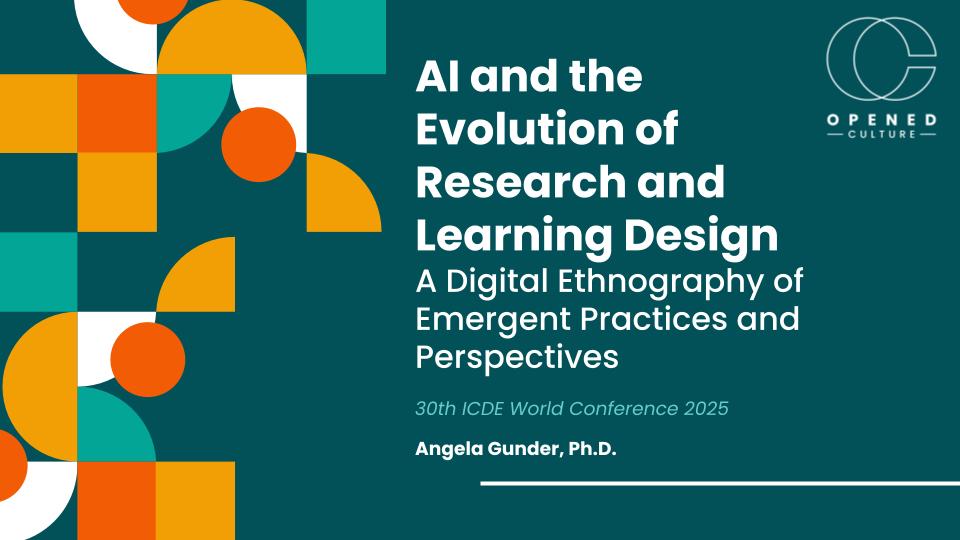
This paper and its companion presentation were developed for the 30th ICDE World Conference 2025, held in Wellington, New Zealand, from 10–13 November 2025 and hosted by ICDE Institutional Members Open Polytechnic and Massey University of New Zealand. Click on the slide title image below to open the presentation in Google Slides.
Author Reflections
To accompany the in-person presentation, some of the co-authors recorded brief video reflections offering personal context for the research—discussing its relevance to their leadership experiences and its implications for the future of academic innovation.
