Opened Culture is a pioneering collaboratory and strategic consultancy dedicated to empowering educational institutions and communities. We stand as a beacon for change in the educational sector, offering a unique blend of strategic insight, practical support, and community engagement to revolutionize how education is delivered and experienced.


Search
Connect With Us
Do you want a prompt that works for a month and then becomes obsolete? Or do you want the mindsets and skillsets to keep navigating these waters as AI continues to evolve?

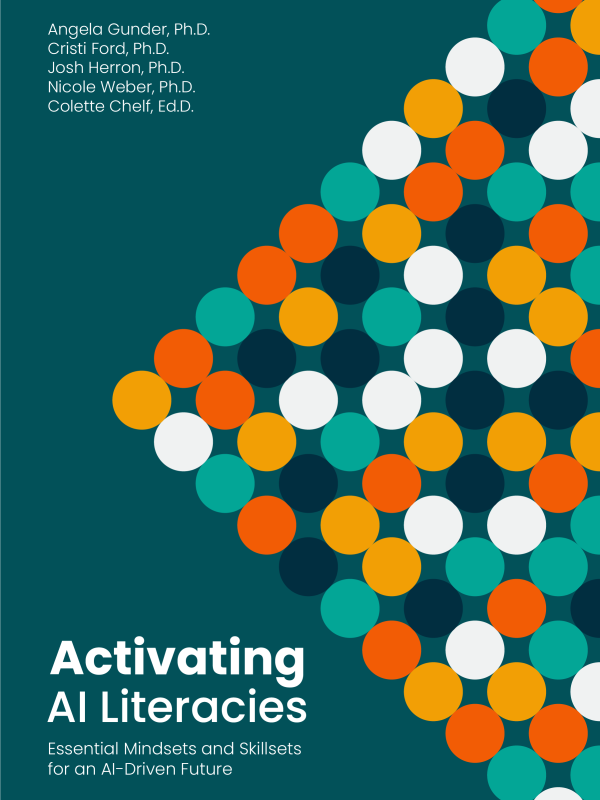
As artificial intelligence reshapes education, what literacies will define our collective future? Grounded in longitudinal global research with educators across six continents, this forthcoming field guide by Angela Gunder, Cristi Ford, Josh Herron, Nicole Weber, and Colette Chelf illuminates eight interconnected dimensions of AI literacies: the constellations of mindsets and skill sets that empower learners, educators, and leaders to navigate complexity and change with intentionality and care.

How might we move from a harmful binary of AI literacy (AI literate vs. illiterate) into a plurality of skillsets and mindsets within a spectrum of AI literacies?

Influenced by the work of Doug Belshaw’s Eight Essential Elements of Digital Literacies, this project seeks to advance the field’s understanding of AI literacies as culturally-contextualized and socially negotiated across formal and informal digital environments. This work brings together collaborators from six continents and over 20 countries in creating a rich resource to spotlight competencies and skills needed for the future of education, work, and society. More than just an open resource, this taxonomy has now expanded into an open course called AI Literacies Unlocked, as well as an open Case Example Database highlighting the constellations of AI literacies as geographically- and temporally-situated across multiple contexts for teaching and learning.

How might we expand and sustain access to quality education at HBCUs through the unique affordances of an opened culture?
Funded by the William and Flora Hewlett Foundation and in partnership with MERLOT and SkillsCommons, this project led by Tennessee State University brings together over 30 HBCUs into hubs that engage in professional development focused on open educational practices and culturally-affirming pedagogies. Addressing the critical need for accessible educational materials, the initiative empowers educators and students at HBCUs and other MSIs to enhance learning through open resources. By supporting these institutions in embedding and sustaining open practices, Opened Culture helps ensure that education is not only accessible but also culturally affirming and reflective of the diverse communities it serves.
How might we identify the competencies and skills employed by educators internationally as they integrate AI into teaching and learning?
Sponsored by UNESCO IITE and Shanghai Open University (SOU), this initiative features the voices of academic leaders and innovators sharing their perspectives, practices, challenges, and vision for the ubiquitous use of AI in education. Entering into its second year, this project has produced a series of open knowledge products, including findings from two qualitative research studies, and the development of open courses on generative AI in education. The first MOOC, which was released by SOU in 2021 and subsequently expanded in 2023 by Opened Culture, has been accessed by 16,000+ individuals from all over the world.
How might we use the levers of an opened culture to envision, design, and implement innovative solutions that will shape the future of learning as we know it?

Born of the collaborative ideation of Lev Gonick, CIO at Arizona State University, and led by ASU’s Enterprise Technology and SAB Creative and Consulting, Opened Culture is providing strategic guidance, advocacy, and community engagement in support of the mission of this collective—to advance access and opportunity through academic innovation so that every learner gets the education they need to thrive. OEC was honored to be featured in the 2074 and 2075 Guide in their spotlight on Future Scenarios: Influential Work, and is one of the leading planners of the next 100 Year Ed Tech Project Design Summit hosted at The University of Central Florida in 2027.

How might we leverage the power of generative AI to illuminate more diverse pathways to instructional design leadership and advancement?

Working in partnership with faculty at The University of Wisconsin-Whitewater, this research study seeks to surface ubiquitous challenges that instructional designers face in locating comprehensive support for designing their future career. From clearly and compellingly demonstrating the competencies and durable skills that employers are looking for in instructional designers to leveraging narrative practices for understanding one’s unqiue value proposition and brand identity as an ID professional, this study interrogates the ways in which generative AI might make the process of career planning a more impactful and empowering experience.

How might we leverage the practices and perspectives of open remixers to drive greater access to education around the globe?
With origins in a research study on the insights and work of educators engaging in the open educational practice of remix, this series of publications and professional development offerings documents the resituating of open remix as a sociocultural construction that can drive communities to expand access to education through open pedagogy. Inspired by a series of portraits of open remixers from around the world, this thought leadership series introduces the “open turn,” which is the movement from a transactional view of open education as product creation into a socioculturally situated view oriented towards the people, perspectives, and practices of open remix.
How might we support educators, leaders, and students at HBCUs in leading the advancement of AI in education?

Inspired by Opened Culture’s HBCU AI Action Guides for Educators, Students, and Leaders, this series of professional development offerings was developed to provide action steps and calls to actions for educators and learners at HBCUs to harness the power of generative AI in teaching and learning contexts. With a focus on empowering the 100+ HBCUs serving over 220,000 students across the US in leading digital learning transformation for an AI-enabled world, these courses were developed for educators of differentiated roles and skill levels to complement emerging and established AI initiatives and strategic plans at the institutional, departmental, and course levels.

OEC-h1-rev2-img-2